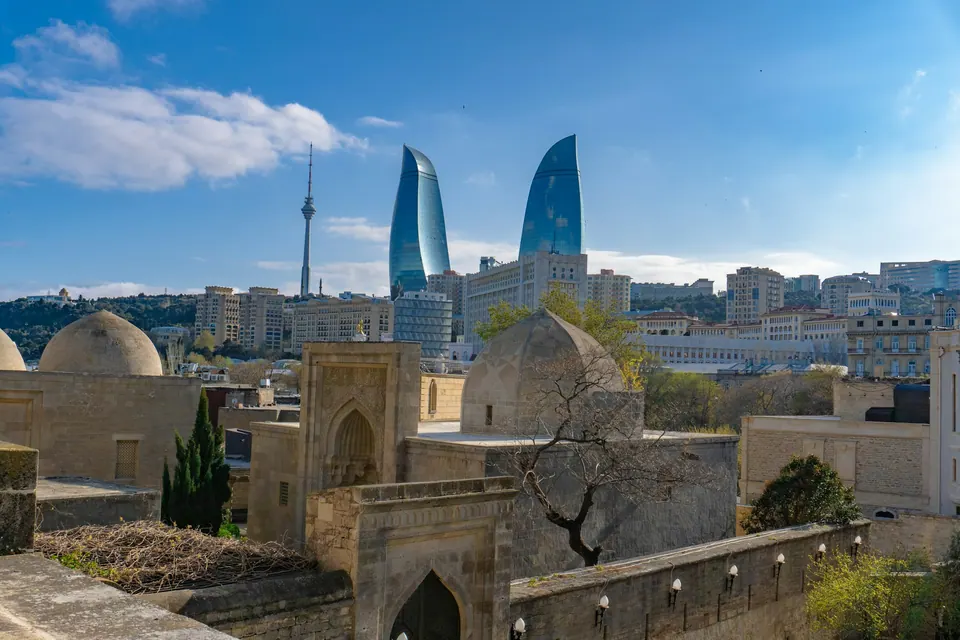
Visiting AzerbaijanDestination
Ateshgah and Yanar Dag: Absheron’s fire sites
What the Ateshgah temple and the Yanar Dag hillside are, why they burn, and how to combine them in half a day with one ticket and due respect for their heritage.
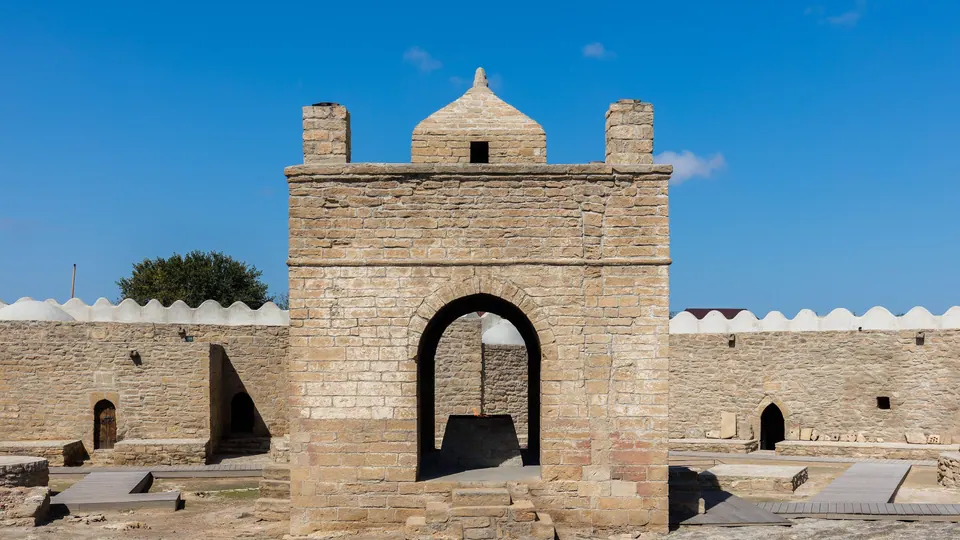
On the Absheron (Abşeron) Peninsula around Baku are two sites joined by fire and different in almost every other way: the Ateshgah temple at Surakhani, a historic place of worship, and Yanar Dag, an open flame burning along the foot of a hillside. A rushed visit can leave you with two good photographs and little sense of what you saw, or with history and legend blurred together. The short answer: Ateshgah is a temple associated at different times with Zoroastrians, Hindus and Sikhs, and its present form dates from the 17th and 18th centuries1; Yanar Dag is a hillside where natural gas leaks out and burns continuously, according to its reserve administration2. The two fit into half a day on a combined ticket of 25 manat per person3,4 (the timing is our estimate, not an official figure).
Ateshgah: the fire temple at Surakhani
The name means “house of fire” or “place of fire”, according to the Reserves Management Center (Qoruqları İdarəetmə Mərkəzi)9. The temple stands where, the reserve administration says, natural gas came out of the ground from ancient times until the 19th century, producing the phenomenon of the “Eternal Flames”5.
The Reserves Management Center describes the temple as a place of worship revered at different times by Zoroastrians, Hindus and Sikhs, and says that its present form was built in the 17th and 18th centuries by the Baku-based Hindu community related to Sikhs1. The building is a pentagonal complex with an open courtyard; at its centre stands an altar in the form of a stone pavilion, with a well in the middle from which burning gas rises1. The reserve administration adds that the temple took the form you see today, without changes, at the beginning of the 19th century, with an entrance portal and battlemented walls5.
The UNESCO Tentative List file, submitted by Azerbaijan, which alone is responsible for its content6, adds that the present buildings date from the 17th century, that the site was a pilgrimage and philosophical centre for fire worshippers from Multan who traded with the Caspian region, and that worship ceased after 1883 when petroleum plants were installed at Surakhani6.
What is documented and what is told
Not every part of the story is equally well established, and keeping the parts apart gives you a truer picture of what you are seeing:
| Account | Who says it | How to read it |
|---|---|---|
| The temple’s present form dates from the 17th and 18th centuries | Reserves Management Center and UNESCO Tentative List file1,6 | A dating of the standing building; the UNESCO file gives the 17th century, and the reserve administration says the temple took its present form in the early 19th century |
| Pilgrims from Multan; worship ended after 1883 | UNESCO Tentative List file6 | A description the State Party gave in its file |
| Zoroastrian roots going back to the 3rd century AD | Ateshgah reserve administration5 | The reserve’s account of an earlier temple, not a dating of the standing building |
| Marco Polo described the Yanar Dag flames | Yanar Dag reserve and the Azerbaijan Tourism Board2,10 | An account both bodies relate, without quoting the source text |
| The Yanar Dag fire inspired Baku’s emblem | Yanar Dag reserve2 | The reserve says this “is believed”, so it is a tradition, not an established fact |
For the first Ateshgah temple, the reserve administration cites a 3rd-century AD inscription by the chief priest on the “Kaaba of Zoroaster”, which says he founded sacred temples in the Transcaucasus, and the Arab geographer Istakhri’s mention in 930 of Zoroastrian settlements near Baku5. It relates that the fire temples fell into decay after Islam spread, that Silk Road trade brought pilgrims back to Surakhani from the early 17th century, and that, according to the German traveller Engelbert Kaempfer, who visited in 1683, they began rebuilding the temple from the middle of that century5.
Yanar Dag: why does the hillside burn?
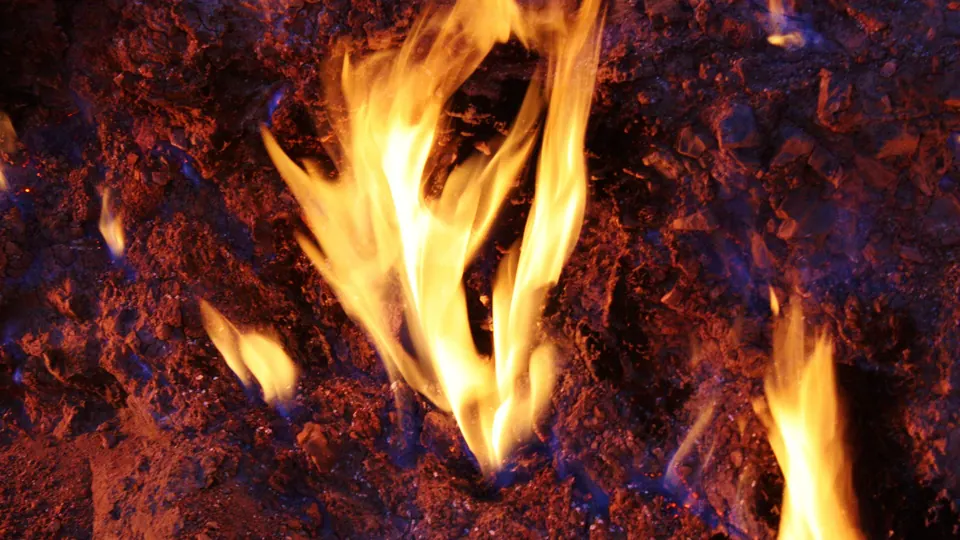
Yanar Dag literally means “burning mountain”, and the site is a hill along which runs a wall of flame that does not go out2. The reserve administration explains that tectonic shifts and volcanic material below the surface cause natural gas to leak from the rocks2. The Tourism Board says the fire burns at the base of a small hillside, fuelled by natural gas leakages11, and that the flames sometimes reach a height of 10 metres10.
The reserve says that another hill on the opposite side burned for thousands of years until its three flames went out a few hundred years ago, when the gas shifted, and that this fire “is believed” to have inspired the symbol of Baku, with its three flames and the sea2. It adds that more burning rocks of this kind once existed around Absheron and were used as sacred places by Zoroastrians in ancient times2.
The reserve was created by presidential decree on 2 May 2007, covers 64.55 hectares, and was placed under the State Tourism Agency in 20182. Today it has a museum and a cromlech stone exhibition, while for the Qirmaki (Qırməki) Valley viewpoint, the mud volcano and the sulphur springs, the reserve asks you to book a guide4.
Tickets and hours: what the two reserves publish
Sources: the “Ateshgah Temple” State Historical-Architectural Reserve and the Yanardag State Historical, Cultural and Natural Reserve. Their pages carry no update date; we read them on 1 October 2026.
What this table covers: the standard adult admission price each reserve publishes for one person, and its opening hours. It does not cover guided tours, transport, the free and reduced categories, or the 35-manat ticket that adds the Mud Volcanoes Tourism Complex.
| Site | Adult ticket | Hours |
|---|---|---|
| Ateshgah temple | 15 manat for foreign visitors, 2 manat for Azerbaijani citizens3 | Every day; hours change between summer and winter8 |
| Yanar Dag | 15 manat for foreign visitors, 2 manat for local visitors4 | Every day, 10:00 to 19:007 |
| Combined ticket for both | 25 manat per person3,4 | Valid for 72 hours after first use3,4 |
What the combined ticket covers. It is for one person only, according to both reserves3,4. Both also list a 35-manat combined ticket that adds the Mud Volcanoes Tourism Complex3,4. By our arithmetic, two separate tickets cost a foreign visitor 30 manat, so the combined ticket saves 5 manat. We quote adult rates only; for free and reduced categories, see the two reserves’ pages. The Tourism Board’s page on the fire sites shows lower prices10; we have followed the reserves’ own pages. These are the reserves’ prices, not ALVERA GLOBAL’s.
Because the Ateshgah reserve does not publish its opening hours on the pages we read, call before you go on +994 12 565 12 8812.
Half a day for both: a suggested plan
This is our planning suggestion, not an official route:
- Start at Ateshgah. Give time to the courtyard and the central altar, then to the exhibition rooms around it if they are open.
- Buy the combined ticket at the first site and keep it for the second, within its 72-hour validity3,4.
- Finish at Yanar Dag. The flames show more clearly as the light fades, so make the hillside your last stop, bearing in mind that the reserve closes at 19:007.
- Do not assume a travel time. Neither reserve publishes the time between the two sites; check it on an up-to-date map on the day.
Respectful and safe conduct
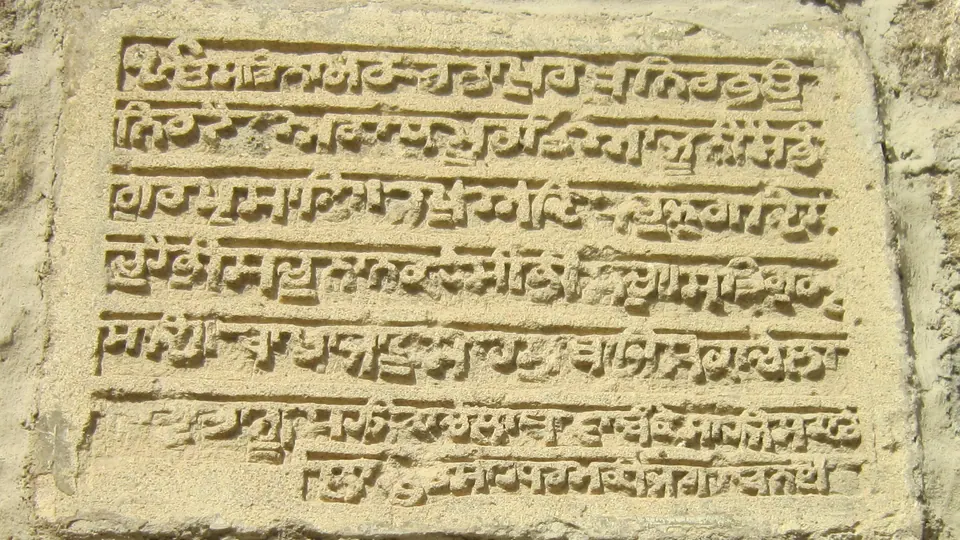
Ateshgah is now an open-air museum10, but it remains a sacred place for some of its visitors: the Tourism Board says that Indian tourists still visit with great enthusiasm and deep respect10. Treat it as you would any place of worship.
- Keep back from the flame. The Azerbaijani version of the Ateshgah reserve’s rules forbids approaching the open fire closer than 0.5 metres8, and the English version closer than 1 metre13; keep to the larger distance.
- Do not touch the exhibits, and do not enter the service rooms, which the Azerbaijani rules call “cells” (hücrələr), unless they are open to visitors8.
- No smoking, alcohol, sound amplifiers or loud talk at the Ateshgah reserve8; at Yanar Dag, smoking is allowed only in designated areas and visitors are asked to avoid loud voices4.
- Photography. The Ateshgah reserve exempts amateur and tourist photography from its ban on unauthorised filming8; the Yanar Dag page says professional photography is not allowed in the reserve and refers you to the administration for more information4.
- Children. Yanar Dag requires children to be accompanied at all times4.
When this plan may not suit you
- Limited mobility. We found no accessibility information on either reserve’s pages; ask each reserve before you go7,12.
- You want Yanar Dag’s outlying natural sites. You will need to book a guide and allow more time4.
Frequently asked questions
Is there one ticket for both sites?
Yes. Both reserves list a 25-manat combined ticket for Ateshgah and Yanar Dag, for one person only and valid for 72 hours after first use3,4. The Yanar Dag page adds that its discount terms apply to combined tickets4.
Is the fire at the Ateshgah temple natural?
The reserve administration says that natural gas came out of the ground here from ancient times until the 19th century5. The official pages we read do not say what supplies the flame you see today, so ask the guide on site. At Yanar Dag, the reserve says natural gas leaks from the rocks2.
Is half a day enough for both?
Usually, yes, if you keep to the temple, the burning hillside and its museum (our planning estimate, not an official figure). For the outlying sites of the Yanar Dag reserve, the reserve asks you to book a guide, so allow longer4.
Sources
Source 1: Reserves Management CenterAteshgah Temple reserve↩
Source details
- Original title
- "Ateshgah temple" state historical architectural reserve
- Source date
- No publication date shown; the page displays "01 Apr 2024 - 31 Aug 2024"
- Accessed
- 1 October 2026
Source 4: Yanardag reservePlan your visit↩
Source details
- Source date
- Undated (no date shown)
- Accessed
- 1 October 2026
Source 5: Ateshgah Temple reserveAteshgah: the fire temple↩
Source details
- Original title
- "ATESHGAH" - FİRE TEMPLE
- Source date
- Undated (no date shown)
- Accessed
- 1 October 2026
Source 6: UNESCOSurakhany, Atashgyakh on the Tentative List↩
Source details
- Original title
- Surakhany, Atashgyakh (Fire - worshippers, temple - museum at Surakhany), Baku
- Source date
- Date of Submission: 30/09/1998
- Accessed
- 1 October 2026
Source 8: Ateshgah Temple reserveVisitor rules (Azerbaijani)↩
Source details
- Original title
- QAYDALAR
- Source date
- Undated (no date shown)
- Accessed
- 1 October 2026
Source 9: Reserves Management CenterAteshgah Temple (Azerbaijani page)↩
Source details
- Original title
- "Atəşgah məbədi"
- Source date
- No publication date shown; the page displays "01 apr 2024 - 31 avq 2024"
- Accessed
- 1 October 2026
Source 10: Azerbaijan Tourism BoardSites of ancient fire↩
Source details
- Original title
- sites of ancient fire leave a burning legacy
- Source date
- Undated (no date shown)
- Accessed
- 1 October 2026
Source 11: Azerbaijan Tourism BoardIn the abode of flames↩
Source details
- Original title
- in the abode of flames an exciting adventure
- Source date
- Undated (no date shown)
- Accessed
- 1 October 2026
Source 13: Ateshgah Temple reserveVisitor rules (English)↩
Source details
- Original title
- RULES
- Source date
- Undated (no date shown)
- Accessed
- 1 October 2026
Related articles
More in Visiting Azerbaijan
Baku’s Old City: a visitor’s plan
What to see in Baku’s walled Old City, in what order, which museums need a ticket, and how to plan a well-paced visit.
Sheki: Khan’s Palace and trip planning
What to see in Sheki, whether to go for a day or stay the night, how to get there from Baku, and what to confirm before you travel.
When to visit Azerbaijan: a season guide
Choose when to visit Azerbaijan by the trip you want: city and sights, mountains in summer, snow in winter or Novruz, with official climate figures.